Effective Distribution of Cases Between Courts: Pilot Project on Trans-Territorial Jurisdiction in Commercial Proceedings Discussed
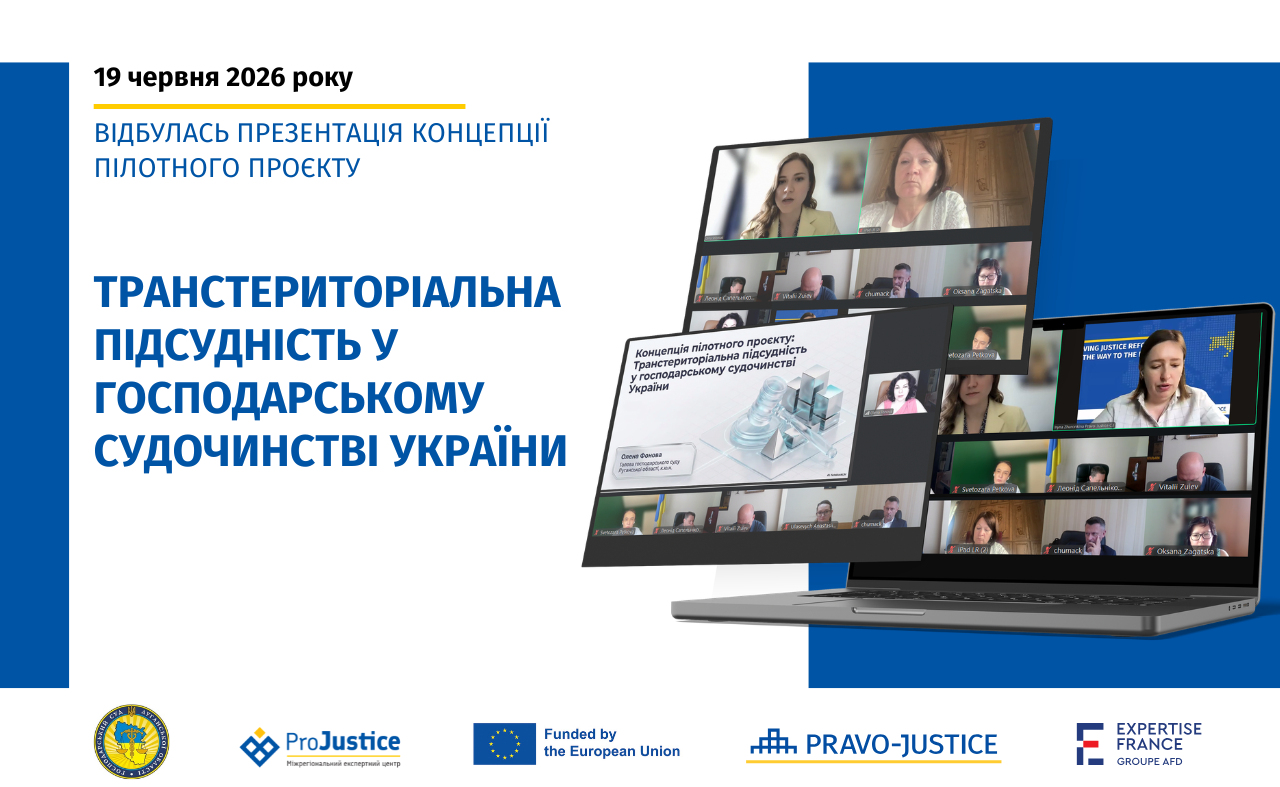
On 19 June, EU Project Pravo-Justice supported the discussion of the concept of the pilot project “Trans-Territorial Jurisdiction in Commercial Proceedings in Ukraine”. The event was attended by representatives of the Supreme Court, the Commercial Cassation Court within the Supreme Court, the Ministry of Justice of Ukraine, the Council of Judges of Ukraine, the European Bank for Reconstruction and Development, the High Council of Justice, the High Qualification Commission of Judges of Ukraine, and the State Judicial Administration of Ukraine.
“After the start of the full-scale aggression, commercial courts faced not only new categories of disputes, but also serious challenges in the field of court administration. The relocation of businesses has resulted in a significant difference in workload between courts. At the same time, it is extremely important for us to ensure that cases are resolved quickly, as this directly affects the functioning of the economy. That is why we are looking for additional mechanisms that will allow us to use the available resources of the judicial system more efficiently,” said Larysa Rohach, Chief Justice of the Commercial Cassation Court within the Supreme Court.
Olha Sribniak, Deputy Team Leader of EU Project Pravo-Justice, noted that another important context for discussing this topic was the shortage of judges in courts, which could not be overcome quickly. This means that alongside the selection and appointment of judges, there is a broader discussion on how to optimise workloads while maintaining access to justice, legal certainty, judicial independence, and the quality of case processing.
“That is why this discussion is important. We hope that it will help to outline not only possible procedural models and institutional architecture for implementing such a solution, but also the boundaries, conditions and guarantees without which no jurisdiction-related change can be properly assessed,” said Olha Sribniak.
Olena Fonova, President of the Economic Court of Luhansk Oblast and co-founder of the NGO ‘IREC Pro Justice’, presented the concept of a pilot project on trans-territorial jurisdiction in commercial cases.
“Today, the commercial courts of Kyiv, Odesa and Dnipro regions are dealing with a much larger volume of cases, while some courts have a reserve for taking up additional proceedings. The development of the Unified Judicial Information and Telecommunication System and automated case distribution open up opportunities for new solutions. We propose to test a mechanism that will allow for more rational use of the judicial system’s capacity and ensure faster consideration of cases without violating the rights of the parties to the process,” said Olena Fonova.
According to her, the project is proposed for piloting primarily in summary proceedings, a category of cases characterised by a high level of standardisation and digitalisation. In 2025, commercial courts considered more than 11,500 such cases, which is about 12% of all commercial proceedings.
Oleksandr Oliinyk, Director of the Directorate of Justice and Criminal Justice of the Ministry of Justice of Ukraine, noted that the Ministry of Justice had already developed a concept and legislative proposals on trans-territorial jurisdiction, and a study conducted with the support of the EBRD confirmed that this approach complies with European standards. However, in order to implement it, it is necessary to get an answer to the question of whether trans-territorial jurisdiction violates Article 125 of the Constitution of Ukraine, as well as what should be the procedure for appellate review of cases and the consequences of a possible change in the form of proceedings. He also noted that it was necessary to obtain statistical data to assess the impact of the new model on the workload of courts and actual terms of trials.
“It is important that the decision to introduce trans-territorial jurisdiction is based on European experience and informed by objective data on its impact on the efficiency of court proceedings,” said Oleksandr Oliinyk.
Svetozara Petkova, consultant at the European Bank for Reconstruction and Development and author of the study on flexible territorial jurisdiction, presented the experience of Bulgaria, where a similar mechanism is already used to redistribute cases between courts. According to her, after the reform was implemented, summary proceedings started being automatically transferred from the busiest courts to courts with a lower workload. In just eight months, almost 100,000 cases have been redistributed, which has significantly reduced the imbalance in the judicial system.
“Bulgaria’s experience has shown that the trans-territorial distribution of cases can be an effective tool for reducing the imbalance in the workload between courts. Ukraine has good prerequisites for implementing this approach thanks to the development of e-justice and the use of e-cabinets,” said Svetozara Petkova.
“EU Pravo-Justice Project is ready to provide further support in seeking approval and implementation of trans-territorial case processing. Taking into account the issues and possible risks raised by the participants of the discussion, the implementation of the pilot project in commercial jurisdiction seems quite reasonable,” summed up Iryna Zharonkina, Enforcement and Protection of Property Rights Component Lead at EU Project Pravo-Justice.