310 Probation Managers Received Certificates upon Completing the Managers’ School
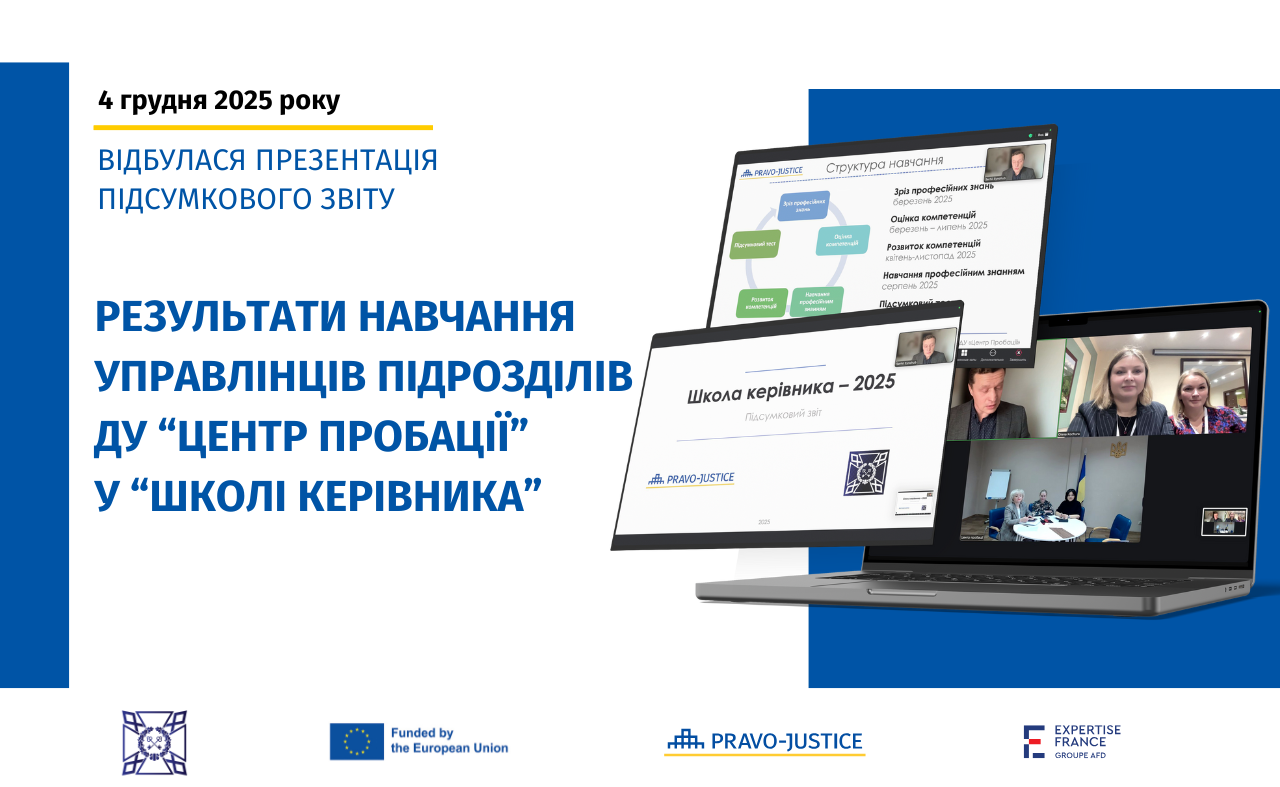
On 4 December, EU Project Pravo-Justice experts Serhii Synohub and Olena Kochura presented a final report on the outcomes of training for probation managers of the Probation Centre who took part in the Probation Managers’ School. The training course was developed by the Probation Centre with the support of EU Project Pravo-Justice to improve management efficiency, strengthen corporate culture, and develop leadership and team motivation.
Over a period of eight months, from April to November, 488 probation managers took part in a comprehensive programme to develop their managerial skills. As a result, 310 participants received certificates of completion. To receive a certificate, they were required to meet a number of conditions: attend all training events (no more than three absences were allowed, or four absences for frontline regions) and score at least 50% on the final test.
The Managers’ School covered five key modules: personnel management, recruitment and onboarding, motivation and preventing burnout, training and development, and conflict management. An additional module was devoted to improving probation managers’ hard skills. A total of 87 training sessions were held.
“An effective probation manager is not just an administrator, but above all a leader who knows how to motivate, inspire and develop their team. We taught managers to think strategically, make informed decisions and work with people based on trust. This is the foundation of a modern, pro-European probation service focused on change and development,” said Serhii Synohub, national expert of EU Project Pravo-Justice and lecturer at the Managers’ School.
Olena Kochura, Key Expert on Reforming the Penitentiary System and Probation at EU Project Pravo-Justice, emphasised that it is important for probation managers and staff to keep learning and improve their skills.
“Developing managerial competences is not only a matter of professional growth for probation managers, but also a guarantee of a sustainable reform. EU Project Pravo-Justice supports the establishment of a modern professional development system that builds a new generation of probation leaders who are people-centred, results-oriented, and committed to European best practices,” she emphasised.
The survey results showed that probation managers are keen to continue their training, both in developing professional competencies and managerial skills. The most relevant topics identified by participants for future training include working with veterans, assessing the risk of reoffending, supervisory probation, using digital tools, modern methods of social and educational work, and working with the Unified Register of Convicts and Detainees.
In the area of managerial skills, the participants showed the strongest interest in leadership, strategic thinking, change management, team motivation, time management, communication and emotional competencies – qualities that are particularly important in the context of the transformation of the probation service.
“The professional development of probation managers is a long and consistent process. Thanks to the support of EU Project Pravo-Justice, we were able to create a sustainable educational platform that not only disseminates knowledge but also shapes a modern managerial culture focused on development, efficiency and respect for people. We hope to have further phases of training, which will be a logical continuation of this path forward,” said Viktoriia Kliuch, Head of the Human Resources Department at the Probation Centre.